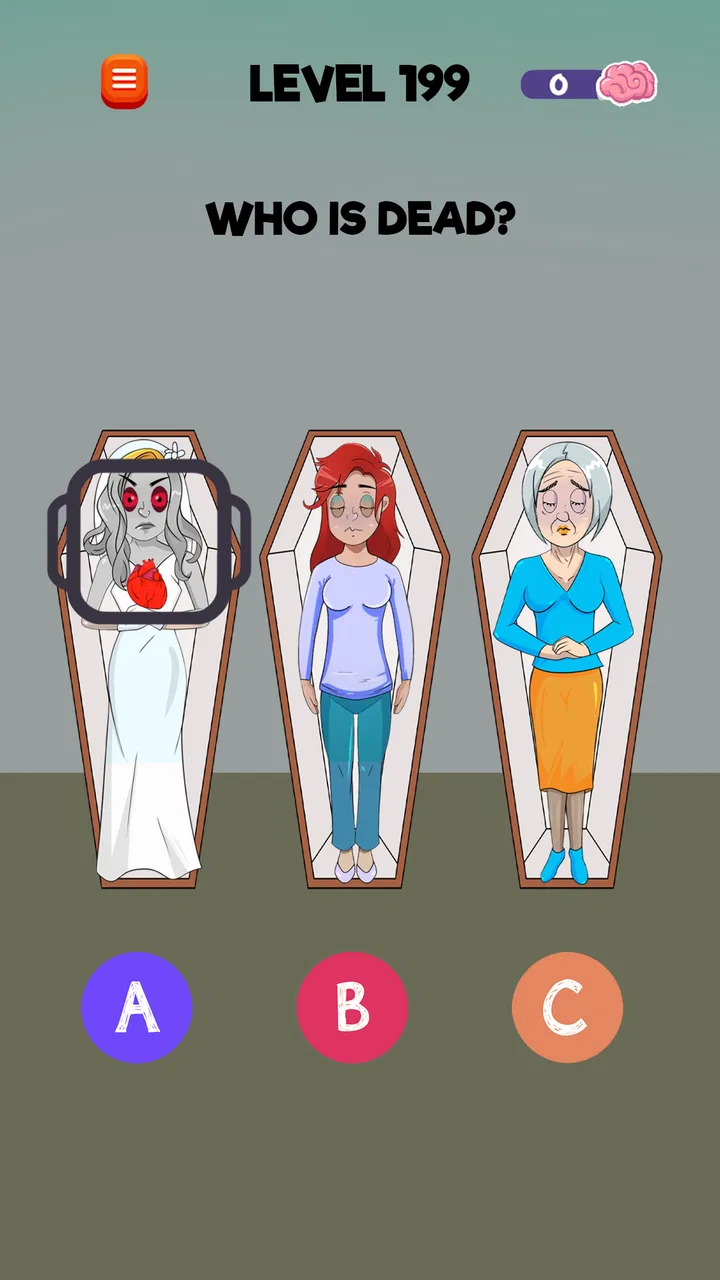
Riddle Test: Brain Teaser Game
- 4.0
- Rating
- 5.00M
- Installs
- Free
- Price

 Analysis by App-foxy
I spent time with Riddle Test: Brain Teaser Game as a quick word-game companion rather than as a serious study tool, and that distinction matters. It is built around riddles, quizzes, mind puzzles, and IQ-style challenges that ask you to interpret wording carefully, spot a trick, and keep trying when the obvious answer turns out to be wrong. The basic appeal is immediate: open it when you have a spare moment, solve a few puzzles, and put it away without needing a long session.
That makes it an easy recommendation for people who enjoy verbal puzzles and short bursts of mental exercise. I also found it more useful as a social game than its simple format first suggests. A confusing riddle can become a good conversation starter, especially when one person sees a literal answer and another notices the wordplay. At the same time, anyone looking for a structured language course, a competitive multiplayer experience, or a deep logic simulator should set expectations differently. This is a casual word game from Kidding Box Studio, and its strengths come from accessibility and variety rather than from elaborate systems.
How the game feels in everyday use
I find this game easiest to enjoy when I treat each riddle as a small change of pace, not a test I need to rush through. Reading the wording twice before choosing an answer can turn a near-guess into a satisfying solve, and it also makes a puzzle easier to share with someone nearby. That everyday rhythm leads naturally to what matters most: how the game responds as I work through a question.
You May Also Like

 Blood Strike: 2.5 Anniversary
Blood Strike’s Loadouts Turn Every Drop Into a Tactical Gamble
A close look at Blood Strike’s custom loadouts: how fast access to signature weapons reshapes its battle royale rhythm, rewards preparation, and narrows the gap between fights.

 Pandora - Music & Podcasts
Pandora’s Music Is Easy to Start, but Harder to Recover
Pandora’s strength is its low-effort path from a seed to a station. Its weak spot is how much confidence it asks you to place in connection, setup, and quiet recovery.

 8 Ball Pool
 Is Built on Rivalries, Rematches, and Routine
A close look at the rivalries, rematches, shared routines, and unanswered safety questions that turn a quick pool match into a persistent mobile community.

 Samsung Music
’s Quiet Strength Is Playing What You Already Own
Its reach comes less from spectacle than from dependable access to a personal library. That simplicity is both the app’s strongest retention engine and its ceiling.

 AccuWeather: Weather Radar
AccuWeather Review: A Quick, Clear Forecast for Everyday Decisions
For everyday plans, the best forecast is the one you can understand quickly. AccuWeather makes rain timing, radar, and local conditions easy to act on, with a few trade-offs.

 Hill Climb Racing
Why Hill Climb Racing Still Turns Crashes Into One More Run
A tiny car, a bumpy hill and one more upgrade: Hill Climb Racing keeps resurfacing because its simple chaos makes every near-miss feel personal.
More From Our News Desk



Quick starts and sensible speed expectations
The first thing I noticed is how naturally the game fits into small gaps in the day. I could approach a puzzle without preparing for a long play session, which is useful when waiting for an appointment, taking a break from work, or relaxing before bed. The question-and-answer structure keeps the focus on the current challenge, so I did not feel that I had to learn a complicated interface before getting to the interesting part.
Its perceived speed depends less on demanding action and more on how quickly I can read, interpret, and decide. That is a good match for this genre. A fast response from the device is helpful, but the real pause usually comes from the riddle itself. Some questions are solved almost immediately; others need a second reading because the wording is designed to pull me toward a familiar answer.
For that reason, I would not judge the experience by how many puzzles I can rush through. The better measure is whether the game lets me move smoothly between thinking, answering, and continuing. In my experience, the lightweight presentation supports that rhythm. It feels designed for mental pauses rather than for visual spectacle, and that keeps the attention on the words.
There is also a useful difference between speed and difficulty here. A puzzle may appear simple and still take time because the intended solution depends on a small linguistic twist. When I played while distracted, I made more mistakes not because the controls were difficult, but because I skimmed the question. My practical advice is to read every word before answering, particularly when the sentence sounds almost too easy.
What happens during longer or heavier sessions
Short sessions are the natural home for this game, but I also tried treating it as a longer brain-teasing activity. That changes the experience. After several puzzles, I began recognizing the general style of challenge, which helped me think more flexibly but also made some questions feel less surprising. The game works best when I take occasional breaks instead of turning it into a marathon.
Heavy use can mean different things for different players. For one person, it is solving a handful of riddles during a commute; for another, it is sitting down and attempting one challenge after another. The second approach puts more pressure on concentration than on the phone. I found that mental fatigue became the main limitation. When I rushed because I wanted to maintain momentum, I missed clues that were clear when I returned with a calmer attitude.
This is one of the more useful ways to use the game: alternate between independent solving and discussion. I sometimes read a difficult prompt aloud and asked someone else what they thought. That turned a stalled puzzle into a small collaborative exercise without requiring a separate multiplayer mode. It is particularly suitable for families or friends who enjoy arguing over whether an answer is clever, overly literal, or simply unexpected.
Another practical habit is to stop after a frustrating run rather than repeatedly guessing. Repeated attempts can make me fixate on the first interpretation that came to mind. Leaving the puzzle for a while gives the wording a chance to reset in my head. This is not a technical feature, but it improves the way the game feels during extended use and prevents a casual activity from becoming needlessly irritating.
Stability, interruptions, and returning to a puzzle
Reliability matters even in a small word game because the whole appeal is convenience. I expect to open it quickly, solve something, and leave without ceremony. In my use, the simple format made that expectation reasonable. There are no action-heavy scenes or complex controls competing for attention, so the experience feels comparatively straightforward.
Still, a stable experience is not the same as a perfect one. Any app can be affected by the phone, the operating system, background activity, or an interruption such as a call. I would not install this expecting the same kind of resource planning needed for a large three-dimensional game, but I would still keep ordinary habits: close demanding apps if the phone is already struggling, keep the system updated, and avoid judging the game from one unusual session.
Recovery is most important when I am interrupted halfway through thinking. A riddle game should let me return to the question without making me reconstruct a complicated chain of actions. That is where this format has an advantage over games that require a long sequence of moves. Even if I put the phone down, the central task is easy to understand again because the puzzle itself remains the focus.
I also like that the game does not need a high level of physical precision. If a tap is missed, the problem is usually easy to identify and correct. The challenge is mental rather than reflex-based, so a brief interruption does not destroy the entire session. That makes it more forgiving for casual use than a timed action game, although players who dislike restarting a thought after every distraction may still prefer playing in a quiet place.
Older phones and device limitations
The minimum requirement is Android 7.0, which gives the game a broad reach across Android devices that are not necessarily new. That is helpful for readers who do not own a recent phone and want a word game rather than a demanding graphical title. The current version is 2.1.6, so I would check that the device meets the system requirement before trying to install it.
Because the core activity is reading and answering puzzles, screen quality affects comfort more than raw gaming power. A small display can make longer text less pleasant to read, and a dim or damaged screen may make careful wording harder to notice. If you are choosing between devices, I would prioritize readable text, a responsive touch screen, and enough battery for your routine rather than focusing on performance specifications aimed at action games.
Storage and resource expectations should also be kept realistic. I would not choose this title for a device-management test or assume it offers the same technical demands as a large console-style mobile game. Its appeal is that the phone is mainly presenting text and interaction. That makes it a sensible candidate for modest hardware, while still leaving the usual caveat that an older device may have slower app launching or more aggressive background cleanup.
There is one device-related trade-off that is easy to overlook: a game based on language is only as comfortable as the player’s reading environment. On a crowded bus, with glare on the screen and constant interruptions, a puzzle can feel harder than it really is. At home, with the text clearly visible, I could concentrate on the intended twist. In other words, perceived difficulty sometimes comes from the situation rather than the riddle.
Who will enjoy it, and who should choose something else
I think this is a strong fit for people who like riddles but do not want to commit to a long campaign. It also suits players who enjoy testing their assumptions. The game rewards patience, careful reading, and a willingness to consider an answer that is less obvious than the first one. If you often send puzzle questions to friends or enjoy quiz nights, the format should feel familiar and easy to share informally.
It is less suitable for someone who wants a measurable training plan. The presence of IQ-style challenges may suggest a formal assessment, but I would treat the results as entertainment rather than as a meaningful evaluation of intelligence. The puzzles can exercise attention and flexible thinking, yet solving them is not the same as receiving a scientific cognitive profile or a personalized learning program.
I would also point competitive players toward a different category if they need live opponents, rankings, or a deep progression system. Riddle Test is better when the goal is to solve the question in front of you. Likewise, people who prefer visual puzzles, number grids, or word construction may find a dedicated crossword, Sudoku, or spelling game more satisfying because those alternatives focus more narrowly on their preferred skill.
For parents, the Teen content rating is worth considering before installing it for a younger child. The rating does not make it an automatic choice for every family situation. I would look at the actual store presentation and decide whether the style of puzzles suits the child, especially if the device is shared. The game can be a pleasant family activity, but I would not present it as an educational product simply because it asks the player to think.
Free access and the cost of continuing
The game is free to download, which makes trying it relatively low-risk. That is important for a casual title: I can see whether the riddle style suits me before deciding whether it deserves regular space on my phone. There are in-app purchases ranging from $0.99 to $29.99 per item, so I would review any purchase prompt carefully rather than assuming every part of the experience is included without cost.
My advice is to decide in advance how you want to use the game. If you only want occasional puzzles, the free entry point may be enough for your routine. If you are tempted to spend during a frustrating moment, pause first and ask whether the purchase improves the kind of experience you actually want. Paying to move past a difficult riddle may provide convenience, but it can also remove the satisfaction of solving the problem independently.
This is one area where the game differs from a traditional paperback puzzle book. A book offers a fixed collection that you own physically, while an app is easier to carry and interact with but may present purchase decisions within the experience. Compared with a completely free web search for random riddles, this game has the advantage of a focused interface, though a search engine gives you more control over topic and difficulty.
How it compares with familiar word-game alternatives
Compared with crossword apps, this game feels more immediate and less dependent on building a large grid of crossing answers. I do not need to maintain a long chain of partially solved words. That makes it friendlier when I have only a few minutes, but it also means players who love the steady structure of a crossword may find the individual riddles less substantial.
Compared with spelling games, the emphasis is not simply on knowing vocabulary or arranging letters correctly. Interpretation matters more. A player with a broad vocabulary can still miss a question by reading too literally, while someone who enjoys lateral thinking may perform well even without advanced word knowledge. That makes the game approachable, although it can feel subjective when the intended answer depends heavily on phrasing.
Compared with Sudoku and other number puzzles, this is a more language-dependent experience. Sudoku offers a consistent logical framework that can be analyzed step by step; these riddles can change their rules from one question to the next. I prefer this when I want surprise and variety. I prefer Sudoku when I want a stable system where every deduction follows the same type of logic.
That comparison explains the game’s most distinctive trade-off. Its variety keeps individual questions from feeling mechanically identical, but the same variety can make difficulty less predictable. If you want a carefully graduated learning curve, a dedicated training app may be better. If you want a portable collection of verbal traps that can be picked up whenever your attention is available, this title has a clearer advantage.
Small strategies that make the puzzles more enjoyable
My first practical tip is to separate the literal reading from the playful reading. On the first pass, I ask what the sentence plainly says. On the second, I look for an unusual word, an assumption, or a detail that would be unnecessary if the obvious answer were correct. This two-stage approach helped me avoid guessing too quickly and made the solutions feel less arbitrary.
Second, I recommend saying a stubborn riddle aloud. Hearing the wording can expose a double meaning that is easy to skim silently. It also makes the game work well as a shared activity: one person can read the question while another proposes interpretations. This is a more rewarding use than simply tapping random answers until something works.
Third, keep track of the reason you missed a puzzle, not just the answer. I found three common mistakes in my own play: overlooking a small qualifier, assuming the question meant something broader than it did, and choosing the familiar response before checking the wording. Recognizing those patterns improved my approach more than memorizing individual solutions would have.
Finally, use it as a reset between demanding tasks rather than as a substitute for rest. A few puzzles can redirect attention, but a long run of difficult questions may become another form of mental work. The best everyday scenario for me was a short break after finishing a focused task: enough time to change gears, not so much that I returned feeling more tired.
My performance verdict after regular use
From a performance perspective, this is a modest, focused game whose demands are primarily cognitive. I would expect it to be more comfortable on ordinary Android hardware than a visually intensive game, provided the device meets Android 7.0 and the screen is easy to read. The simple puzzle format also makes interruptions less disruptive than they would be in a real-time title.
Its perceived responsiveness is tied to the quality of the reading experience. A quick launch is useful, but the real success is whether the interface gets out of the way while I think. Riddle Test generally benefits from that restraint. It does not need to overwhelm the player with effects to make a question interesting, and that helps it remain suitable for short, low-pressure sessions.
The main friction is not demanding hardware; it is the possibility of uneven personal reactions to the riddles. Some players will enjoy the surprise, while others may dislike questions that feel dependent on wordplay or a particular interpretation. The free-to-start model is welcoming, but the in-app purchase range means I would remain attentive to spending, especially if I were handing the phone to someone else.
Its audience size suggests that the concept has found a substantial casual following: the game has passed five million installs, with an average rating of four stars from around thirty-eight thousand ratings. Those figures do not replace personal testing, but they do make it easier to see why the format appeals to many people. It is approachable, portable, and simple to explain to a friend.
The developer, Kidding Box Studio, has positioned this as a word-focused thinking game rather than a full educational course or competitive platform. I think that is the right way to approach it. Download it if you want quick riddles, mental detours, and occasional group discussion. Skip it if you need rigorous scoring, a guaranteed difficulty progression, or a puzzle system with no dependence on language nuance. For my use, the best reason to keep it installed is its ability to turn a few empty minutes into a small, satisfying thinking session.
Overall, I would recommend Riddle Test: Brain Teaser Game to casual puzzle fans who enjoy being surprised by wording. It is free to try, supports short sessions well, and should not demand the kind of device resources associated with larger mobile games. Just treat its IQ framing as playful, read carefully, and remember that the most enjoyable way to play is not always the fastest way to finish.
FAQs for Riddle Test: Brain Teaser Game
01What is Riddle Test: Brain Teaser Game?
Riddle Test: Brain Teaser Game is a mobile app designed to challenge your mind with a series of creative and thought-provoking puzzles. The game offers a variety of riddles that test your logic, lateral thinking, and problem-solving skills. It's a fun way to improve your cognitive abilities while enjoying a playful gaming experience.
02Is Riddle Test suitable for all age groups?
Yes, Riddle Test: Brain Teaser Game is designed to be accessible to all age groups. The app provides puzzles that range in difficulty, making it suitable for both children and adults. However, younger players may need some assistance with more complex riddles, offering a great opportunity for family collaboration.
03Are there in-app purchases or ads in Riddle Test?
Riddle Test: Brain Teaser Game is free to download and play, but it may include in-app purchases and ads. These purchases typically allow users to unlock additional hint packages or remove ads. While ads support the free version, they can be disabled through a one-time purchase for a more seamless experience.
04Does Riddle Test require an internet connection to play?
Riddle Test: Brain Teaser Game can be played offline, making it convenient for users who want to enjoy the game without an internet connection. However, some features, such as downloading new riddle packs or accessing certain updates, may require internet access to function properly.
05How frequently are new riddles added to the game?
The developers of Riddle Test: Brain Teaser Game regularly update the app with new riddles to keep the experience fresh and engaging. Updates may vary, but players can generally expect new puzzles to be added every few weeks. This ensures a continuously challenging environment for users who enjoy solving riddles.
Pros
- Engaging puzzles boost critical thinking.
- Variety of levels keeps gameplay fresh.
- User-friendly interface enhances experience.
- Offline mode available for on-the-go play.
- Frequent updates with new riddles.
Cons
- In-app ads can be disruptive.
- Some riddles may feel repetitive.
- Limited hints without in-app purchases.
- Occasional bugs affect gameplay.
- Graphics could be more visually appealing.

Riddle Test: Brain Teaser Game
Gallery